what was created to organize the production of war materials
Introduction
World War Two was the largest and most violent armed conflict in the history of mankind. Nevertheless, the one-half century that now separates us from that disharmonize has exacted its toll on our collective noesis. While World War II continues to blot the involvement of military scholars and historians, besides as its veterans, a generation of Americans has grown to maturity largely unaware of the political, social, and military implications of a war that, more than any other, united us as a people with a common purpose.
Highly relevant today, Earth War Ii has much to teach us, not only about the profession of arms, but also well-nigh military preparedness, global strategy, and combined operations in the coalition war against fascism. During the adjacent several years, the U.S. Army will participate in the nation'due south 50th anniversary commemoration of World War II. The commemoration volition include the publication of various materials to aid educate Americans about that state of war. The works produced volition provide bang-up opportunities to larn about and renew pride in an Ground forces that fought so magnificently in what has been called "the mighty endeavor."
World War Ii was waged on country on sea, and in the air over several diverse theaters of operation for approximately six years. The following essay on the wartime mobilization effort supplements a series of studies on the Army's campaigns of that war.
This brochure was prepared in the U.South. Army Middle of Military History by Frank N. Schubert. I hope this absorbing business relationship of that period volition raise your appreciation of American achievements during Globe War II.
GORDON R. SULLIVAN
General, The states Regular army
Chief of Staff
Mobilization in World War Ii
The mod process of preparing armies for war originated in the middle of the nineteenth century. The recruitment of volunteers to fill up the ranks no longer sufficed. Governments turned to conscription, created huge forces, and harnessed their national economies to conduct war. The give-and-take mobilization was first used in the 1850s to describe the preparation of the army of Prussia for deployment. The American Ceremonious War marked the appearance in the United States of the typhoon and mass armies, along with the organization of productive resources to sustain them. The volunteer tradition of the minutemen was on its fashion to becoming little more than a sacred retentivity, and the logistical simplicity of the American Revolution was gradually falling by the wayside. The era of mobilization�the reallocation of a nation's resources for the associates, preparation, and equipping of forces for war�had arrived.
The very size of the forces assembled during the Civil State of war, with millions of men under artillery at 1 time or another, bespoke a new era. Moreover, the principle of a national war machine obligation was successfully asserted by both sides, and the Confederacy sought to organize its economy to prosecute the war. In the years that followed as the United States became an industrial power with interests beyond its borders, this growing stature and the wartime experience in Republic of cuba, the Philippines, and along the Mexican border compelled Congress and military leaders to recollect more about mobilization issues. In 1903 the Army caused a General Staff, whose mission included planning for mobilization and defense force. Thereafter, signs of a broader conception of the Ground forces's part appeared in revised field service regulations and in training exercises involving e'er-larger troop organizations.
World State of war I
The United States went to state of war on the side of the Allies in Apr 1917 without stockpiles of equipment or plans for creating them. Worse, the Regular army had no clear thought of the character and magnitude of its wartime needs and no detailed specifications for product of many kinds of equipment. Had such plans existed they would have been of little apply anyhow considering so little was known almost the nation's industrial capacity, including the location and productivity of various industries. What lay ahead was improvisation in the face
[iii]
of unforeseen crises to compensate for inadequate planning and training.
At least the main manpower issue was soon solved. In May 1917 President Woodrow Wilson approved a draft constabulary. The Selective Service Organisation that was built-in in the Earth War was based on universal susceptibility and selective service. Although a national system, it was locally administered and based essentially on consensus rather than coercion. The system became the basis for raising wartime armies for the next five decades.
Producing equipment, supplies, and facilities turned out to be a far greater challenge than manpower. The Army had no experience with big business. The independent, decentralized bureaus at the eye of the supply organization, left over from Indian-fighting days, often seemed more adept at defending their individual prerogatives than supplying a big ground forces. Equally the Army and the Navy competed with each other for products, raw materials, and plant capacity, bureaus forced up prices, increased production costs, and generated excess profits. The bureaus also caused astute congestion of transportation facilities, almost paralyzing the war attempt.
In response to these difficulties, President Wilson established the State of war Industries Lath in July 1917. This lath eventually under Bernard Yard. Baruch, coordinated purchasing by agencies of the Regular army and Navy and stock-still production priorities. Other agencies tended to deed in concert with the board's resource allotment decisions. The Fuel Administration, for example, looked to the board for mining machinery and the priorities on which information technology shipped coal. The armed services likewise depended on the lath submitting their needs for scarce items to determine allocations and transportation priorities.
The centralized determination of priorities nether the board facilitated logistical consolidation within the War Department, with Maj. Gen. George Westward. Goethals of Panama Canal fame in charge. The process forced the Army to settle its own questions of priority before dealing with the board. Afterward the bureaus resolved their internal priorities, they sent their requests to the Army priorities officer in Goethals' Purchase, Traffic, and Storage Partition. In that location, conflicts amidst bureaus were resolved earlier requests went to the War Industries Board. Though success was a long time coming and the effort was always hindered by a lack of information regarding requirements and resources, the board under Baruch, went a long fashion toward achieving the cardinal control needed to manage the wartime economic system.
The industrial performance of the nation in support of mobilization was remarkable. At the war'south terminate the Us had an army
iv
of over 3.5 1000000 and huge equipment surpluses. There was no longer any question about the nation'south ability to marshal the resources for war. As logistics historian James Huston noted the U.s. "had revealed the greatest war-making chapters that the globe had e'er seen.
Still unclear was the nation's willingness to learn the war's lessons about preparedness. It was plain that the materiel side of mobilization was the most costly, complex, and fourth dimension consuming. The war, Assistant Secretary of War Benedict Crowell said had "upset the previous opinion that adequate armed services preparedness is largely a question of trained manpower."
The Interwar Years
The adjacent two decades saw the first serious peacetime efforts to deal with shortcomings on the materiel side, only a full awareness of the claiming came simply gradually. The National Defense Human activity of 4 June 1920 charged the banana secretary of war with planning for industrial mobilization and responsibleness for the State of war Department's procurement. The act represented a first stride toward recognizing that modern warfare, with its demands for huge mechanized ground forces armed with sophisticated weapons and the ability to move over large fronts, demanded that the entire national economy be harnessed.
Recognizing the scope of this relationship between the economy and the capacity to make war, Baruch suggested in the 1920s that mobilization exist placed on a broader footing. He proposed planning for procurement of industrial materials in wartime through articulation committees of industrialists and military officers. Only his suggestions were never acted upon. At the fourth dimension, America had retreated into isolationism, and the prospect of having to engage in some other large conflict seemed remote. So, recognition that mobilization required government control of the economy did not lead immediately to the establishment of a cardinal mobilization planning bureau.
With the banana secretary in charge, bodily planning for identification of the Ground forces's needs was done in the War Plans Division of the General Staff. 2 major innovations marked the early years of Army staff planning. Ane was the establishment of the joint Ground forces and Navy Munitions Board in June 1922. This board fabricated upwards of the assistant secretaries of the two services, brought the Navy, a potential competitor for wartime resource, into the planning process. By 1929, the lath adopted a articulation strategy, and two years afterward, the board expanded to include a permanent executive committee. The other innovation was
5
the creation of the Army Industrial College, the get-go institution of its kind. The i-yr curriculum gave officers the chance to report mobilization from a wide variety of perspectives. Faculty and students contributed to the grooming of the industrial mobilization plans that emerged in the 1930s. The establishment of the lath and college showed vision and an understanding that mobilization transcended the Army.
In 1923 the General Staff produced its first peacetime programme for the assembly of an army. The program called for 6 field armies with a strength rising from 400,000 on the day of mobilization�known as M-twenty-four hour period�to ane.3 million in four months and increasing every month thereafter. Information technology acknowledged that the availability of supplies and equipment determined the rate at which troops could be captivated. However, the program neglected the critical outcome of the resource needed to create the supplies on which mobilization depended. It assumed that product would adjust to strategic plans, expanding when necessary and contracting when not. It also left unresolved the question of whether different plans were needed for different contingencies.
This initial plan incorporated the outmoded World State of war I concept of M-day as the basis for planning. In the summer of 1914 the European armies, i after the other, had mobilized on specific G-days, triggering complex and patently irreversible processes that followed rigid timetables. These mobilizations generated similar responses from adversary armies and fabricated hostilities almost inevitable. Just Grand-day as a concept and tool for planning was more user-friendly than helpful. It fabricated no allowances for gradual changes in preparedness or a measured transition to a mobilized land. Instead information technology posited an overnight complete conversion. In the interwar menses the One thousand-day fixation kept American planners from visualizing any situation that required implementation of mobilization measures before the official outbreak of war.
The programme's showtime thorough revision in 1925 failed to correct this shortcoming. In fact, the 1928 plan represented a step backward giving supply a secondary position and putting the emphasis back on manpower. Materiel, only recently considered the pacing cistron, was assumed to take intendance of itself. Men would simply be equipped supplied and trained as they entered service.
While these plans for the assembly of forces for war were being developed split plans for wartime procurement were under way in the War Section. The assistant secretary's part relied on the supply services for detailed planning on wartime procurement, a task that was clearly understood to be office of the armed forces mission. Procurement
6
planning for mobilization involved assessing the types of supplies and equipment needed to meet given emergencies and calculating quantities needed at specific intervals. Each supply branch had its ain procurement planning section as early on as May 1921. In the 1920s the needs of the War Department represented the bulk of requirements for a war product program. The supporting mobilization plans for raw materials, labor, power, fuel, and transport, too as the associated evolution of economic controls, were seen as derivative functions.
Past 1930, procurement planning had gone far enough that State of war Department attention could turn to a system for presidential control and direction of industry in an emergency. Moreover, with the Army finally using up its World War I surplus stocks, new procurement was becoming disquisitional. Depression-era retrenchment, near severe in 1933-34, still held dorsum purchasing. All the same, an upwards trend in appropriations followed and procurement planning expanded. Information technology included surveys and the allocation of manufacturing plants among the procuring services, along with product studies and even occasional "educational" orders�small actual orders that gave manufacturers experience with military specifications and standards and other aspects of providing needed supplies to the Regular army. This procedure added realism to the program.
Industrial mobilization planning, as understood by the end of the 1920s, concerned all activities necessary to ensure the success and minimize the burdens of wartime procurement. The series of industrial mobilization plans that started in 1930 and culminated in 1939 finally came to grips with the old assumption that supplies would simply be available when needed. The plans besides went beyond the function of the Army and examined how the nation should organize the control of industry in state of war. Implicit was the expectation that management of the economy and particularly, command of industry in wartime were presidential functions that would be exercised through temporary agencies run and largely staffed by civilians. This assumption reflected a realistic agreement of the American political system and the transcendent graphic symbol of industrial mobilization. The issue was bigger than any i service or department.
The plans showed familiarity with the tools for wartime economical control, from preference lists and priorities for facilities and commodities, to control of strange merchandise, and as a last resort, to the establishment of government corporations, toll controls, and seizures. The editions of 1930, 1933, 1936, and 1939 amounted to administrative blueprints for wartime civilian control and direction of the nation'south resources.
7
Each version centered on national agencies that would control production. Early on editions included four superagencies, managing war industries, selective service, public relations, and labor. By 1936, the War Industries Administration, which was understood from the outset to be the largest and nigh important wartime bureau, had been renamed the State of war Resource Administration. Its responsibilities were to include control of war finance, merchandise, labor, and price control organizations, with simply the selective service and public relations still autonomous. The superagency, which would have powers beyond those of the War Industries Board also would exist responsible for acquiring and controlling strategic and critical materials. The plan'south greatest flaw lay in its failure to consider effective control over the allotment of bones materials, such as steel, copper, and aluminum.
In the development of these plans the Ground forces-Navy Munitions Lath showed its usefulness. With the Navy an increasingly active participant but the office of the banana secretary of war withal the driving force, the board sponsored the industrial mobilization plans of the 1930s. In then doing, it actually became a transitional agency, until the institution of the projected civilian superagency at the starting time of war. Equally such, the board drew up lists of disquisitional materials, studied raw material needs, and eventually obtained modest appropriations for importing and stockpiling critical materials. The lath besides made industrial surveys and apportioned productive capacity of firms and industries whose products were sought by both services. By mid-1939, President Franklin D. Roosevelt recognized the lath's importance past placing information technology in the executive office of the president. Thereafter, Roosevelt had direct control of the board which in turn enjoyed unanticipated prestige and visibility.
By 1939, the industrial mobilization plans broke free of the M-day concept. That year's plan stipulated that the War Resources Administration should be established as early as practicable when an emergency was envisioned. No longer would economical mobilization for war be tied to the actual outbreak of hostilities. The policy change tacitly recognized the increasingly hostile international environment and the long lead-times necessary to produce the increasingly sophisticated tools of state of war.
The Protective Mobilization Plans
While the industrial mobilization plans dealt with wide national aspects of planning, the Army staff prepared a serial of protective mobilization plans that began to announced in the mid-1930s. Each con-
8
Army and Navy Munitions Board, with Executive Committee,
27 June 1941. Left to correct: Brig Gen. Charles Hines, USA;
Brig Gen. H. Yard. Rutherford, USA; Robert P. Patterson, Nether
Secretary of War; James Forrestal, Nether Secretary of the
Navy; Capt. E. D. Almy, USN; Capt. A. B. Anderson, USN.
Back row: Maj. G. Chiliad Heiss, Us, Assistant Executive
Secretary; Col. H. S. Aurand, The states; Comdr. V. H. Wheeler,
USN; and Comdr. L. B. Scott, USN (Ret.). (National Archives)
centrated straight on the Ground forces'due south role in a possible disharmonize. They addressed the size and composition of an initial defensive strength and its support. Although starting with more sophisticated assumptions that took into account industrial resources and capabilities, these plans were essentially descendants of the plans and procurement studies of the 1920s.
The protective mobilization plans bridged two gaps. They sought to mesh product schedules and the early needs of the Army to join the rates of troop and materiel mobilization. In add-on, they provided for a small and well-equipped emergency strength, called the initial protective force, to provide security during general mobilization. Basically, this strength of 400,000 consisted of the then bachelor Regular Army and National Guard.
Overall, the 1939 version was sound enough to become the permanent basis for mobilization. The plan provided for training, incor-
9
porating the location, size, and schedule for establishing grooming centers; outlined detailed unit and individual training programs; and provided for the product of manuals and associated training material. It established a point of departure, a organization for mobilization of the men and equipment already available. Like the industrial plan of the same twelvemonth, the protective plan stepped dorsum from the M-day assumption and began to see mobilization every bit a process that should begin well before the U.s.a. became involved in a war. The program neglected the important area of construction of adequate troop housing and other facilities, simply otherwise it was a succinct, coherent proposal based on realistic assumptions.
Political variables that mobilization planners could not control and may not have understood were however pregnant. The soundest plan was useless if-the state was not prepared to accept information technology. Although Japan, Italy, and Frg actively pursued policies of imperial expansion in 1939-40, domestic realities in the United States included a public largely alienated from participation in world diplomacy. The twenty years since the finish of the Nifty War had seen the breakdown of an international organization based on the League of Nations and arms limitation agreements. The resultant American disillusionment with international affairs expressed itself in potent isolationist and pacifist sentiments.
Although President Roosevelt neither shared nor pandered to this viewpoint, he understood the strength of the isolationist position. With one center on his upcoming reelection bid in 1940, he acted carefully. Some of his New Deal supporters, notably labor leaders, feared that a preparedness drive centered on a powerful War Resources Administration would undermine much contempo social legislation. So, rather than begin a massive central rearmament effort, he launched a limited preparedness campaign at the offset of 1939, with his emphasis on increasing the striking power of the Army Air Corps. The Army, in turn, used the opportunity of the air buildup and the $575 1000000 appropriation for a more than counterbalanced expansion. Momentum picked up after the German invasion of Poland in September and the outbreak of a general European war. Proclaiming a express national emergency, Roosevelt authorized an increment to 227,000 for the Regular Army and to 235,000 for the National Guard.
Despite abandonment of the industrial mobilization plan, the starting time of mobilization could exist discerned by the end of 1939. The president was moving in a way unforeseen by the planners of the 1930s, with no superagency atop a network of coordinating and integrating machinery. Roosevelt did agree on an alternate construction, accepting Assistant Secretary of War Louis Johnson's proposal to fix up a War
10
The War Resources Lath. Back row: Comdr. A. B. Anderson,
Naval Liaison Officeholder; Admiral Harold R. Stark; Dr. Karl
Compton, President, Massachusetts Institute of Technology;
John L. Pratt, Director, Full general Motors Corp.; Full general
George C. Marshall, Chief of Staff, Us; and Col. H. 1000
Rutherford. Front row: Dr. Harold G. Moulton, President, the
Brookings Institution; Charles Edison, Banana Secretary of
the Navy; Edward R. Stettinius, Chairman of the Board, US.
Steel Corp. (Chairman); and Louis Johnson, Assistant
Secretarial assistant of War. (DA photograph)
Resources Lath to propose the Munitions Board on economic mobilization policies, survey materials and facilities, plan for price controls, and study special issues, such as the production of synthetic safe. The board was six weeks old when a hostile public reaction, based on the lack of labor or farm representatives, convinced the president to abandon it.
The U.S. mobilization pace picked upwards in the wake of German military machine successes in the spring of 1940. This phase, unremarkably called the defense period) represented a transitional stage similar to the one envisioned by the abandoned industrial mobilization programme. In May 1940 Roosevelt chosen for 50,000 new aircraft and a supplemental defense appropriation. He also set upward an Office of Emergency Direction in his executive part to coordinate the endeavor, and he revived the
11
Advisory Commission of National Defence to appraise issues of mobilizing resource and to prepare comprehensive plans for various stages of mobilization. But the commission itself did not last the twelvemonth, and its successor, the Office of Production Management, was also presently abolished. The political climate was yet not receptive to a total-scale industrial mobilization.
Although full-scale mobilization remained politically incommunicable, the government started the financial transition from parsimony to affluence. Appropriations came faster than the Army could blot them, over $8 billion in 1940 and $26 billion in 1941, dwarfing the half billion dollars that had been allotted for expansion early in 1939. By the fourth dimension of Pearl Harbor, Congress had spent more than for Army procurement than it had for the Regular army and the Navy during all of World War I.
While the industrial mobilization programme indirectly influenced rearmament, the protective mobilization plan had a more direct bear upon. The latter plan prevented some of the foundering that had taken place in April 1917 by providing the basis for the Army's initial expansion. The Army still saw its role as protecting the U.s. and the Western Hemisphere from hostile European forces rather than participating in global coalition warfare, an supposition that express and impeded planning. Only the protective mobilization plan at least gave the Army a starting betoken in preparing for a hemispheric defense force mission.
The gradual and somewhat experimental path of mobilizing the economy during 1940 went contrary to public expectations. M-day connected to be in the popular listen) and few understood that mobilization was, in fact, already under way. Mobilization was substantially an evolving situation, in which the United States was not formally at war and was reacting to the spread of conflict by moving from ane set of expansion goals to another.
Although the president had taken control of mobilization, the Army still had a key role in shaping it. The Ground forces was the single most important claimant on productive resources and manpower, so its needs largely determined the nature and extent of the process. Both industrial mobilization and procurement started with the formulation of requirements by the Army. Once the Army knew the kinds and quantities of materiel it needed' facilities, materials, manpower, free energy, and other resources could be brought to behave on production. Beyond the demand for an authoritative Army shopping list lay a web of relationships between troop mobilization, which depended on the bachelor supplies, equipment, and facilities; materiel requirements;
12
and the availability of industrial chapters and raw materials that express the scale and pace of mobilization. In 1940 and early 1941, with the Army still assuming that it would be charged mainly with hemispheric defence force and not enough known about the capacity of industry, meaningful decisions were beyond the ability of the War Department and the Full general Staff.
The Munitions Program
The munitions plan of June 1940, the clearest applied manifestation of the defence period represented an effort to estimate and cope with the anticipated expansion of the forcefulness. Its goals included the procurement by October 1941 of all items needed to equip and maintain an army of 1.two million, including the Air Corps, and creation of product facilities to support an army of over four million. Directed by the Regular army and Navy Munitions Board, this programme set up a priorities system, apportioned industrial capacity betwixt the services, cleared foreign contracts for munitions product in the United States, and compiled armed forces needs for strategic raw materials. Procurement districts, arsenals, depots, and other establishments were activated and expanded. The $6 billion that was allotted was just half of the War Department's asking, simply it was almost as much as the nation had spent on the section between 1922 and 1940 and a major turning point in the rehabilitation of the Army.
In terms of the production of the materiel needed for any expansion of the Ground forces, the start of the munitions program constituted M-day. However, the concept was not invoked at the time. Passage of selective service legislation awaited the render of Congress in the autumn. In fact, the beginning peacetime draft in the nation's history became police in September, i calendar month after the president federalized the National Guard. There was little indicate in announcing an M-day for materiel and then waiting 3 months to announce another for manpower. Those who idea almost the sequence, though, knew that if the two aspects of mobilization had to be divide, materiel should come kickoff. Even though the sequence was correct, the needs of the force of ane.5 million that was assembled past June 1941 were largely unmet. As had so often happened in the by, troops were being mobilized before equipment was bachelor.
Although the thought of a central agency to manage mobilization never actually took hold before the The states declared state of war, a network of agencies, activities, and controls was emerging to manage state of war production. Some were necessary because of the technical and
13
Under Secretary
Robert P. Patterson.
(National Archives)
technology difficulties inherent in the mass production of novel and complex military items. Others were needed to classify and manage resources, the scarcity of which complicated and frustrated product. The concept of civilian command too remained.
While the government foundered in its search for effective centralized control that accommodated political realities, the War Department itself did somewhat better. Henry Fifty. Stimson had taken over the section at the start of the defence menstruation and brought Robert P. Patterson with him. In December 1940 Congress had agreed to Stimson's asking for transferring to the War Department say-so over certain service aspects of industrial mobilization and procurement and assuasive him to appoint Patterson undersecretary to supervise these tasks. Previously an assistant secretary had responded to the congressional mandate in section 5a of the National Defense Act of 1920. Now, every bit the Regular army's chief mobilization and procurement planner, Patterson operated directly nether the secretary, unifying direction of the department. The Army, whose interwar planning had assumed potent ceremonious command of mobilization, had been unprepared for the lack of centralization. Patterson thus filled what amounted to an administrative vacuum in this try. He proved to be an excellent option.
14
Construction
Patterson concentrated on creating the productive facilities that were essential to increasing output as well as on procurement itself. In the summer of 1941 he brought Michael J. Madigan, a canny millionaire construction engineer, to his office as special assistant to deal with construction. Mobilization severely strained extant facilities for housing, training, and supplying the troops. Just as important were structure and expansion in conjunction with industry of factories to produce supplies and equipment for the expanding Army. Madigan and Patterson agreed that this organization was too slow and complex. Construction for production and for troops had been divided betwixt the Corps of Engineers and the Quartermaster Corps after the engineers took over Air Corps construction from the overburdened quartermasters late in 1940. Early in December 1941 Stimson agreed to their proposal to make the Corps of Engineers responsible for all military structure. Then they took their nine-folio memorandum to the president, who jotted "OK FDR" in the margin. And so, a multibillion dollar mobilization issue was settled, and construction, a pacing gene for both production and troops, was in the hands of the engineers.
There was more to this problem than finding a capable construction amanuensis. Troop construction ultimately mushroomed into a $7.5 billion programme, but the lack of industrial facilities constituted a greater barrier to mobilization during the defense force menstruum. The Low had created much idle merely largely obsolete industrial capacity. With need depression, in that location had been no incentives to modernize. The government had to encourage industrial expansion before its armed forces were engaged. "To take delayed the structure of such facilities until the United States was actually involved in battle," R. Elberton Smith observed in his book on industrial mobilization, "might have lost the state of war before information technology began."
The Roosevelt administration thus encouraged private expansion of facilities for state of war production, first through accelerated depreciation, and so by government financing. Private structure companies did most of the actual building, while other private contractors then received direction fees to operate the plants. The bulk of factories producing ordnance were built this way.
Lend-lease, a program started in September 1941 to provide materiel for those nations already at war with the Centrality, also helped stimulate production. From the commencement, the Allies expected that the master contribution of the United States would be its industrial capacity. The imperatives of this support program required careful
xv
balancing of the manpower needs of industry and the armed forces. The Soviet Union, reeling nether the German invasion of June 1941, was particularly desperate. A calculated hazard, lend-lease ultimately delayed mobilization by reducing, for instance, the number of shipping available to the U.S. Army Air Corps; the program slowed training. Afterwards strange munitions help likewise became a trouble to other Army elements. In the curt run, however, lend-lease helped generate the need that activated assembly lines. The policy of encouraging recipients to utilize standard American military equipment helped assure that factories produced the correct items and enabled planners to divert these supplies to American use when needed.
The Victory Plan
In 1941 the munitions program of the defense phase evolved into the "victory program." At showtime, increases in the force for the protective mobilization program and the procurement of the equipment to meet this expansion were made piecemeal. But the desperate need for a coherent plan became plain equally the Ground forces went through eight separate expenditure programs between August 1940 and June 1942. Each expansion required the supply services to prepare tentative lists of their needs. Their accumulated statements were reviewed, revised, and presented to Congress as the footing for a budget request. After Congress appropriated the money, the Ground forces staff officer responsible for logistics, known as the K-4, approved each expenditure plan, unremarkably with minor modification. A total of about $34 billion was spent in this way.
From early in 1941, Maj. Gen. James H. Burns of the Office of the Assistant Secretary of War advocated studies that would determine full demands of the war on American productivity. At the president'due south direction, the War Plans Division of the General Staff undertook this attempt for the Army, working with the Navy staff, using appropriate assumptions of probable friends and enemies and believable theaters of operations. The resultant program, developed mainly by Maj. Albert C. Wedemeyer, rested on a calculation of the number of troops who would be available and the strategic supposition that the major endeavor would be in Europe, with 1 July 1943 set as the engagement at which maximum strength would be reached. On this basis, the Army G-4 determined the materiel needs of the service, including weapons, vehicles, uniforms, and thousands of other articles needed to equip and maintain the strength.
The production requirements of the plan, merged with the Navy's needs, became known every bit the victory programme. This name indicated a
16
President Roosevelt, left, looks on as Secretary of State of war
Stimson draws the outset capsules in the National Lottery
for selective service registrants in October 1940. (DA photograph)
definitive shift from the focus on hemispheric defense to defeating a potential enemy. The defense force phase was over, and the munitions program was obsolete. The cost of the new plan was staggering, as much as $150 billion, and just the assail on Pearl Harbor made it palatable.
In December 1941 the United States formally declared war in Asia against Japan and in Europe confronting Germany and Italy. By that time, the Army had benefited enormously from peacetime mobilization. It had one-third more people than called for by the protective mobilization plan eight months after a declaration of war. All the same, a massive endeavour was needed to come across the product goals announced past the president in January 1942, including 60,000 airplanes in 1942 and 125,000 more in 1943 and 120,000 tanks in the same menses.
Meanwhile, the Army was expanding. Passage of the Selective Service and Training Human activity in September 1940 showed that the United States was ready to friction match its mobilization materiel with manpower, even in an ballot year. The Ground forces reached its intended strength of 1.5 meg midway through 1941 and had thirty-four divisions and a
17
host of supporting units in grooming by autumn. Lags in cantonment construction forced the War Department to tedious enlistments and delayed the federalization of the National Guard. Just after Pearl Harbor, Congress amended the draft police, lengthening the term of service from ane yr to the duration plus six months and extending registration to all males between eighteen and 65, with those between 20 and 45 eligible for the typhoon. All the while, terminal goals for recruitment became acting goals. By the end of 1942, the Army's strength was at five.4 million, including 700,000 blackness Americans, well-nigh of whom served in segregated back up units.
Wartime Management
Nineteen forty-two was the year of industrial mobilization and the greatest expansion of productive facilities. The War Production Board was established to take control of this process. Creation of a political consensus in support of war was no longer an issue after Pearl Harbor, and the new office had the authority to enforce its policies through granting priorities and allocating resource. The board reflected in many means, the industrial mobilization plan's concept of a State of war Resources Administration. It had tremendous powers to include providing general direction of the procurement and production program, determining the policies of federal departments and agencies with influence on war product and procurement, and administering the granting of priorities and allocating vital materials and product facilities. At the same time, Patterson's office centralized Regular army mobilization efforts in the War Department, with William Knudsen of General Motors deputed a lieutenant general and assigned to the office of the undersecretary as director of production. At last, with the U.s. officially at war, it began to develop the kind of organization that had worked in Earth War I and had been recommended in the industrial mobilization plan.
From this time on, the Regular army and Navy Munitions Board declined in importance, and a new organization emerged within the Army to manage procurement. A command called Services of Supply was gear up in March 1942 under Lt. Gen. Brehon B. Somervell. For the rest of the yr, industrial mobilization to encounter the Ground forces'south needs was his master concern. Full general George C. Marshall, the chief of staff, looked to Somervell as his adviser on supply, and Somervell provided the link between the mobilization and production functions of Patterson's office and the Grand-4 requirements and supply distribution responsibilities. One of the well-nigh skilful empire builders in the mod history of the Army, Somervell
18
Left, General Knudsen (National Archives);
right, General Somervell. (DA photograph)
merged the staffs of the undersecretary's role and the Grand-four into 1 operating agency, the Advisers of Procurement and Distribution, and fastened it to his function. His organization was renamed Army Service Forces in March 1943.
Somervell controlled a vast logistical organization. His authority ranged over six technical services, eight administrative services, 9 corps areas, 6 ports of embarkation, and nine general depots. Formerly, all of these components of the Regular army supply organisation had reported directly to the chief of staff. Together, under Regular army Service Forces, this network bought, stored and distributed the Army's equipment and supplies. The program involved over 600,000 prime contractors and an untold numbers of subcontractors and had a price tag of over $68 billion.
The Ground forces Supply Program provided the design for this huge procurement effort. Showtime published in April 1942, the plan was reissued periodically during the state of war. Each edition contained revised long-range estimates of military needs for all items of supply, honed by teams that studied and updated replacement factors in lite of operational experience. The supply plan lists were translated into terms of raw materials, skilled labor, and productive chapters. With this plan in hand the War Product Board adapted the allotment of priorities to residuum strategic plans with resources and manage possible shortages.
19
The Pentagon under construction.
(DA photograph)
In Army Service Forces, the Corps of Engineers played an important role in the mobilization procedure. Ane of the six technical services under Somervell'south command the corps had a structure program of unprecedented size and scope. Then much of mobilization�production of modest artillery ammunition and the myriad other items in the Ground forces Supply Program, assembly of vehicles and airplanes, and training and housing for the millions of soldiers who were filling the ranks� hinged on engineer construction that it was a pacing cistron for the entire effort. The program included factories, camps, and other facilities for troops; the Manhattan Commune's atomic bomb projection; construction of the Pentagon; and fifty-fifty a few major civil works projects that were continued through the war. The bill came to over $15 billion. Existent manor costs and maintenance added some other $three billion.
At the very top of this endeavour was the War Production Board. It, too, could claim major accomplishments. Under Chairman Donald Nelson, the board inherited from the Army and Navy Munitions Board a system of voluntary priority classifications. Nelson instituted a Production Requirements Plan, through which his board bypassed the
20
armed services and allocated materials directly to producers. In November 1942 this program was superseded by the Controlled Materials Program, modeled on the British experience and adopted at the urging of Ferdinand Eberstadt, chairman of the Army and Navy Munitions Board. This plan rationed the 3 most important industrial materials�steel, copper, and aluminum. Quarterly allocations based on productive capacity bodacious recipients of obtaining the allotted materials on schedule. The program did not bring strong key control to the entire state of war economy, but it did bring order to production while avoiding overregulation. Information technology recognized that production, similar mobilization as a whole, had pacing factors and put the management emphasis there.
Despite the success of the Disquisitional Materials Plan, President Roosevelt changed the management of mobilization in May 1943. The new Office of War Mobilization under James F. Byrnes had broader authorisation, extending to manpower besides as to all functions formerly carried out by Nelson. So Byrnes brought together direction of the two main categories of mobilization. Because of his broad powers, Byrnes became known as the "assistant president."
The merger at the top of manpower and materiel mobilization was of import. By 1943, the Army staff knew that the manpower barrel had a bottom. The pool of reserve manpower represented by millions of unemployed workers had been absorbed labor was becoming scarce, and Roosevelt prepare a ceiling of 8.2 million on the strength of the armed forces. Mobilization was substantially over, having evolved from its gradual beginnings in 1940, speeding upward in 1941, expanding dramatically in 1942, and reaching its summit in production in 1943. For the balance of the way, it was essential for General Marshall and his staff to balance strategy and manpower with sustained high product.
Manpower shortages did cause problems late in the war. By 1944, the scarcity was felt nationwide. The Ground forces curtailed some specialized grooming programs to provide troops where they were nigh urgently needed and expanded the use of express service personnel and women for noncombat duty. Despite the problems, the number of soldiers in the Regular army did not really peak until May 1945, the calendar month during which the state of war against Germany concluded. By and so, the Army'south strength was over 8 one thousand thousand.
By mid-1945, production had long ago reached its zenith. Already in 1944 the War Department had looked at demobilization. War even so raged in Europe and the Pacific, with the United States bringing to acquit an expanding economy while the British neared burnout. American planners grasped the need to expect across the expansion to the aftermath. The Army Industrial College, which had closed just
21
afterward Pearl Harbor, was back in business concern, trying to meet the need for training in contract termination and settlement procedures. After the state of war, information technology connected to study the nation'south experience with economic mobilization.
The Achievement
Despite all of the problems associated with mobilization during World War II, the accomplishment was remarkable. Exploiting the happy conjunction of circumstances offered by idle resources, the protection provided by its insular position, and the heroic resistance of its Allies, the United States developed produced and delivered a alluvion of equipment and supplies for its own and Centrolineal troops. The country showed a preeminent capability for what R. Elberton Smith characterized as "technological warfare on a global calibration" and furnished the Allies with decisive economical and industrial power. This accomplishment, nowhere clearer than in the amazingly successful Manhattan Project, was planned and carried out in a style that accomplished wartime objectives with minimum hardship and dislocation. Sometimes execution of this effort was messy, with overlapping agencies and construction and supply lagging backside recruitment, but the Globe War II experience in the development and utilise of American industrial capacity may well be remembered as the classic case of economic mobilization, running the gamut from planning, through the buildup, to total-scale war production, and finally, demobilization.
22
Further Readings
All areas of mobilization for World War Two are well covered in official publications of the Army. On issues related to military machine manpower, see Marvin A. Kreidberg and Merton G. Henry, History of War machine Mobilization in the Usa Ground forces, 1775-1945 (1955). Civilian labor is covered in The Army and Industrial Manpower, by Byron Fairchild and Jonathan Grossman (1959). R. Elberton Smith, The Ground forces and Economic Mobilization (1959), covers resource allocation, contracting, and procurement, while Lenore Fine and Jesse A. Remington, Construction in the U.s. (1972), deal with building of troop facilities and industrial capacity. Buying Aircraft: Materiel Procurement for the Ground forces Air Forces (1964), by I. B. Holley, Jr., provides split treatment of purchasing and production for the air arm.
CMH Pub 72-32
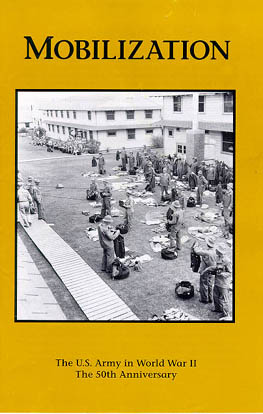
Encompass: Gls concord upwardly items of clothing, 1942. (DA photo)
jenkinsvatimphady.blogspot.com
Source: https://history.army.mil/documents/mobpam.htm
0 Response to "what was created to organize the production of war materials"
Post a Comment